
Empower to Save
Institution:
Catholic University of PortugalCountry:
PortugalDiscipline:
NursingLevel:
BA, MADuration & intensity:
Year-course, 1 ECTSNumber of students:
25Societal need addressed
Increasing community health literacy and capacity to recognize cardiorespiratory arrest and perform first aid actions.
Key competences for Democratic Culture
- Responsibility & respect
- Linguistic, communication and plurilingual skills
- Knowledge and critical understanding of the world
About the course
Capacitar para Salvar (“Empower to Save”) is a face-to-face service-learning initiative developed by the Lisbon School of Nursing, Faculty of Health Sciences and Nursing, Universidade Católica Portuguesa. Created in 2012 as a community health-promotion project and formally integrated into service-learning in 2020, it connects nursing education with a concrete public-health need: strengthening citizens’ ability to recognize cardiorespiratory arrest and act effectively before specialized emergency teams arrive.
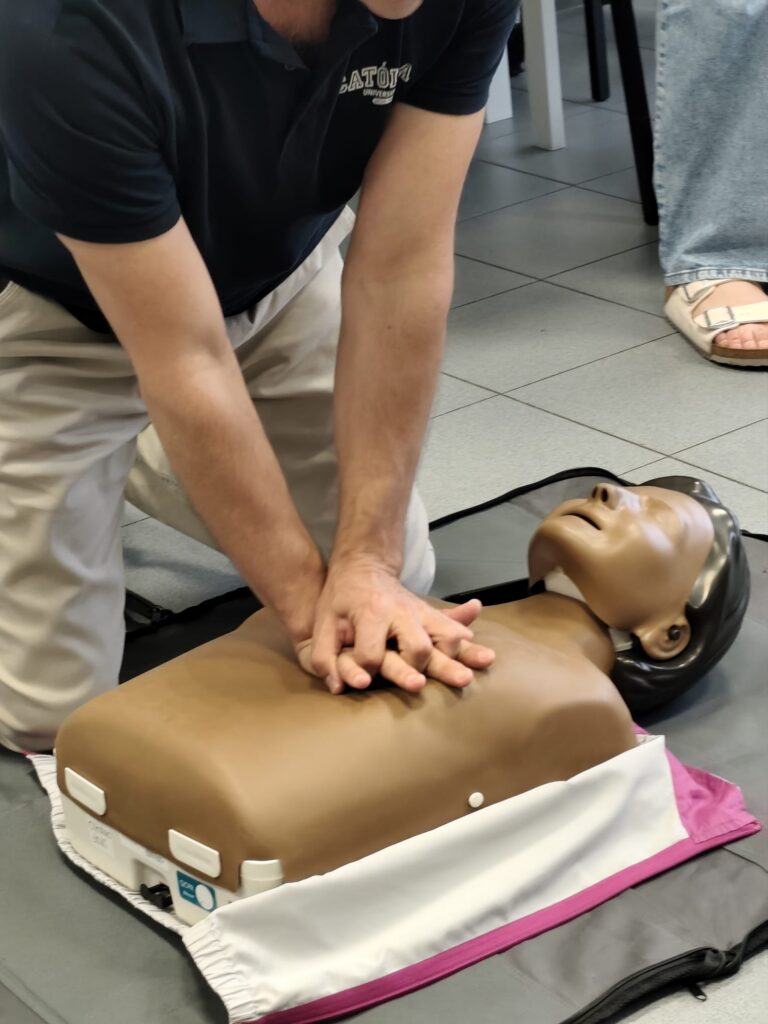
The intervention is planned collaboratively with community partners, who identify local needs, target groups, and appropriate training contexts. Beneficiaries include pre-school and school-age children, young people, formal and informal caregivers, and people experiencing social vulnerability. Each workshop lasts about two hours and combines accessible theory with supervised hands-on simulation. Participants learn to recognize cardiorespiratory arrest, call 112, perform high-quality chest compressions, place a person in the recovery position, and respond to airway obstruction. The program may reach around 400 community members each academic year. Students take an active role in designing, adapting, and delivering the sessions. They learn to communicate clearly with people of different ages, educational backgrounds, health literacy levels, and social circumstances. Through cooperation, feedback, and guided reflection before, during, and after the service, students examine their pedagogical decisions, ethical responsibilities, and the impact of their intervention. This process strengthens their clinical, communication, and teamwork skills while developing flexibility, empathy, critical thinking, and confidence in their ability to contribute to the community.
Reciprocity is central to the project. Community organizations help define needs, host activities, facilitate engagement with beneficiaries, and evaluate the training’s relevance and impact. In return, students learn from authentic situations and diverse communities while providing a practical service that strengthens local preparedness, solidarity, and resilience. Evaluation includes participant and partner questionnaires, teacher assessment, student reflections, and an annual closing meeting. By integrating academic learning, practical training, community partnership, and structured reflection, Capacitar para Salvar transforms life-saving knowledge into shared civic capacity. By integrating academic learning, practical training, community partnership, and structured reflection, Capacitar para Salvar transforms life-saving knowledge into shared civic capacity.
How are Competences for Democratic Culture developed?
By responding to real community needs, students are encouraged to value human dignity, human rights, life, and health equity. They develop civic-mindedness, responsibility, openness to diversity, and respect for people whose experiences and circumstances may differ from their own. Students build knowledge and critical understanding as they consider how social vulnerability, unequal access to health information, and different levels of health literacy can affect people’s capacity to respond in an emergency.
“As a partner organization, ARCIL regarded the Capacitar para Salvar project as a tangible opportunity to promote inclusion and autonomy. The sessions were accessible and highly practical, incorporating visual materials and demonstrations that respected each service user's and caregiver's learning pace. We observed clear improvements in participants’ confidence as they practiced chest compressions, using an automated external defibrillator (AED), and the recovery position. The project also enabled us to refine our internal emergency response procedures. The Service-Learning approach fostered co-design, continuity, and a strong sense of community, bringing together motivated students, better-prepared teams, and safer families. For ARCIL, this is an empowering project that we are committed to sustaining and expanding.”
"This experience strengthened my understanding that health education is a powerful tool for prevention and empowerment, capable of producing tangible, measurable impact. It also deepened my awareness of the importance of such initiatives and of the added value that the Service-Learning methodology brings to the educational process. By integrating scientific knowledge, reflective practice, and social responsibility, Service-Learning proved to be a comprehensive, demanding, and deeply human approach to education. I carry this experience with me not only as a significant milestone in my academic journey, but also as an enduring commitment to the community and to the principles of person-centered nursing care.”
University-Community Partnership
Community partners involved
- Escola de Talentos (Apoio à Vida)
- Centro Social e Paroquial de S. Vicente Paulo
- ARCIL – Associação para a Recuperação de Cidadãos Inadaptados da Lousã
- Associação de Oficiais das Forças Armadas (AOFA)
- Os Trombinhas – Creche e Jardim de Infância (Odivelas)
- Colégio Santa Cruz (Lisboa)
Co-definition of the social need
Training needs in Basic Life Support were identified through close and complementary relationships with beneficiary institutions, some of which have collaborated with the project over several years and others through first contact. Partner institutions communicate their needs to the project coordination team, and planning is carried out in close collaboration with the coordination team and students.
Reciprocity & partner role
Reciprocity is central to the project. Community organizations help define needs, host activities, facilitate engagement with beneficiaries, and evaluate the training’s relevance and impact. They receive face-to-face health education and practical training in Basic Life Support, while students develop clinical, educational, communication, ethical and civic competences through supervised real-world service. The project is sustained by repeated partner requests, feedback questionnaires, final reflection sessions, and annual planning with students and partner entities.
Pedagogical design
Curriculum integration
Capacitar para Salvar (“Empower to Save”) is a face-to-face service-learning initiative developed by the Lisbon School of Nursing, Faculty of Health Sciences and Nursing, Universidade Católica Portuguesa. The project involves undergraduate and master’s nursing students enrolled in curricular units related to human illness, family care, community intervention, and integrated nursing. Although participation is optional, students may earn 1 ECTS through supervised preparation, community service, and structured reflection. The project has been integrated as a Service-Learning methodology since 2020 and has existed as a community health-promotion project since 2012.
Learning objectives
Students learn to apply and teach the Basic Life Support algorithm in diverse community contexts, using effective communication adapted to each target group. They also develop an ethical and humanistic nursing practice grounded in human dignity and the value of life, with active civic intervention among vulnerable populations.
Service & learning activities
Service activities:
- preparation and delivery of health education workshops on Basic Life Support
- theoretical-practical sessions
- simulated practice supervised by teachers/trainers
- training in recognition of cardiorespiratory arrest, activation of emergency services, chest compressions, recovery position and airway obstruction manoeuvres
- delivery of diplomas
- educational flyers to participants
Learning activities:
- Meetings with responsible teachers
- theoretical and practical preparation
- development of educational content and session plans
- simulated rehearsal of sessions with teacher supervision
- implementation of sessions in partner institutions
- collection of feedback
- guided reflection throughout the project
- final reflection/closure
Active role of the student
Students participate actively in planning and implementation: preparing content, designing session plans, rehearsing and adapting strategies to the target audience, delivering the sessions, collecting feedback and reflecting on the pedagogical, organizational and ethical dimensions of the project. They communicate with people of different ages, educational backgrounds, health literacy levels, and social circumstances.
Reflection
Through feedback and guided reflection before, during, and after the service, students examine their pedagogical decisions, ethical responsibilities, and the impact of their intervention. The reflection connects academic learning with community service, enabling students to analyze their communication, teaching strategies, civic responsibility, ethical-humanistic nursing practice, and the impact of their intervention on beneficiaries and partner institutions.
Assessment
- process evaluation of student performance
- final evaluation at the end of the academic year
- questionnaires to evaluate health education sessions
- satisfaction and impact questionnaires for partner organizations, educators/users and beneficiaries
- database analysis of session evaluations
- written reflections/testimonies and teacher evaluation of student participation
Competences for democratic culture
Competences for democratic culture
Values
- Valuing human dignity and human rights
Attitudes
- Civic-mindedness
- Openness to cultural otherness and to other beliefs, world views and practices
- Respect
- Responsibility
- Self-efficacy
Skills
- Analytical and critical thinking skills
- Co-operation skills
- Empathy
- Flexibility and adaptability
- Linguistic, communicative and plurilingual skills
Knowledge and critical understanding
- Knowledge and critical understanding of the self
- Knowledge and critical understanding of the world
How are competences for democratic culture developed?
Students engage with real community needs and diverse publics, including children, young people, formal and informal caregivers and socially vulnerable groups. Through this experience, students are encouraged to value human dignity, human rights, life, and health equity. They develop civic-mindedness, responsibility, openness to diversity, and respect for people whose experiences and circumstances may differ from their own.
Through preparation, supervised service, feedback and reflection, students practice inclusive communication, solidarity, responsibility, ethical decision-making and respect for different social contexts. This process strengthens their clinical, communication, and teamwork skills while developing flexibility, empathy, critical thinking, and confidence in their ability to contribute to the community. Students also build knowledge and critical understanding as they consider how social vulnerability, unequal access to health information, and different levels of health literacy can affect people’s capacity to respond in an emergency.
Outcomes & impact
Learning outcomes for students
- development of competence to teach and apply Basic Life Support in community contexts
- improved health education, communication and pedagogical skills
- stronger civic engagement and responsibility
- greater awareness of vulnerability, equity and community health needs;
- development of teamwork, organization and reflective practice
Community impact
The project aims to train approximately 400 beneficiaries/year, improving community capacity to recognize cardiorespiratory arrest and act before professional help arrives. Participants are trained through safe simulated practice and receive diplomas and educational flyers, becoming potential agents for disseminating information within their communities. Partner feedback and continuing requests for collaboration indicate perceived usefulness and community value.
Challenges & conditions for success
Challenges
- high number of requests from external entities compared with the availability of the project team
- implementation depends on coordination with partner schedules, availability of trained students/alumni/teachers
- appropriate training materials
Conditions for success
- nursing/health expertise
- trained teachers or clinical supervisors
- motivated students
- community partners willing to co-plan and host activities
- Basic Life Support equipment (manikins, AED trainer, pocket mask and audiovisual resources)
- risk/safety procedures
- evaluation questionnaires
- time allocated for reflection and feedback