
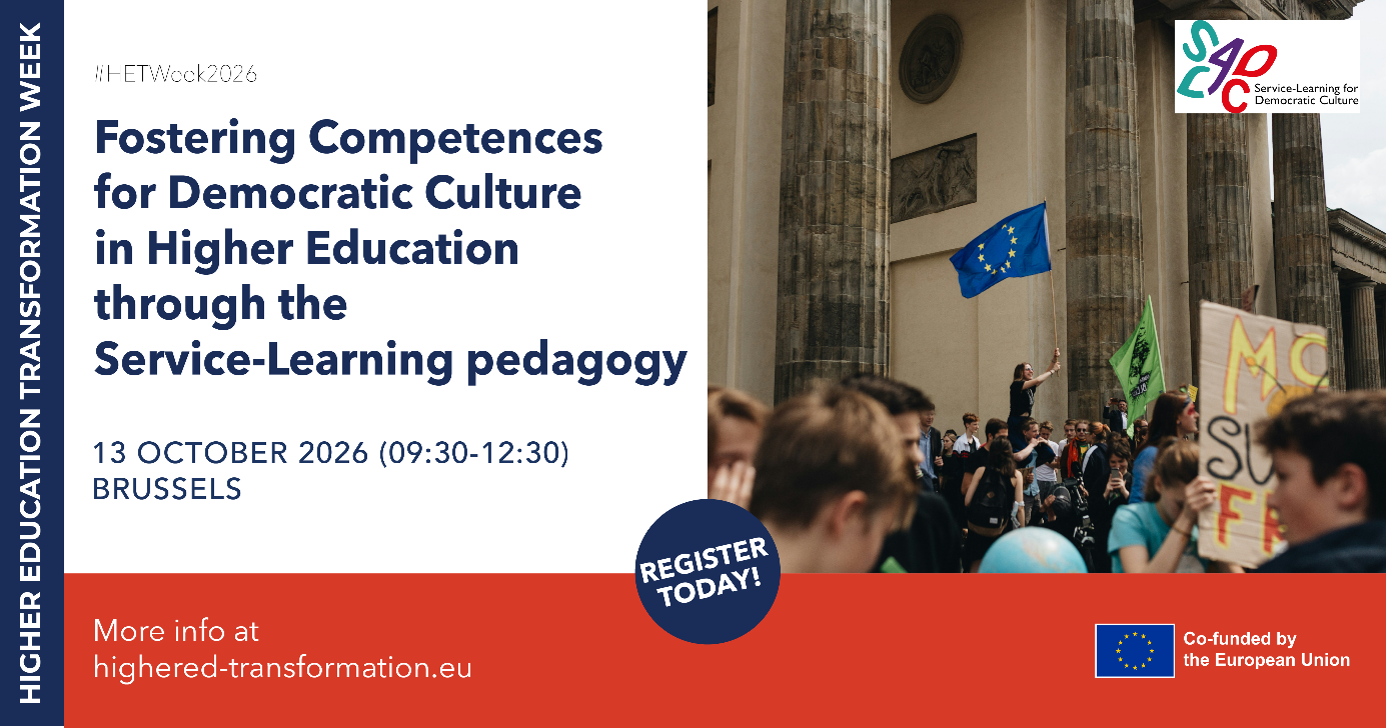
The SL4DC project participates in the very first edition of the Higher Education Transformation Week (HET Week), a initiative of mulitple European organizations aiming to showcase the diversity, creativity, and impact of Erasmus+ KA2 Cooperation Partnerships in higher education in Brussels, Belgium.
Throughout the week, over 40 Erasmus+ KA2 Cooperation Partnership consortia organise free public workshops, conferences, and events across Brussels, offering opportunities to explore innovative practices, project results, and emerging approaches to higher education cooperation, teaching, and learning. The events are clustered over 8 thematic areas:
- Digital & AI Transformation
- Future Skills
- Inclusion and Democratic Engagement
- Mobility & Institutional Cooperation
- Student & Staff Wellbeing
- Sustainability & Green Transition
- Teaching Innovation
- Urban Development
The SL4DC consortium was selected to participate in the HET week with the workshop 'Service-learning: a Pedagogy to Promote Competences for Democratic Culture in European Higher Education', under cluster 'Inclusion and Democratic Engagement'
The SL4DC workshop is planned for Tuesday 13 October at 9h30 at the Odisee Univeristy of Applied Sciences, Campus Hermes and will be facilitated by colleagues Kaat Somers (UCSIA, Belgium) and Loredana Manasia (University POLITEHNICA of Bucharest, Romania) .
At the workshop, participants will be introduced to the service-learning pedagogy and how it contributes to democratic competences as described in the Council of Europe's Reference Framework on Competences for Democratic Culture. For this, we draw from insights from the first phase of the SL4DC project, in which we identified existing service-learning practices fostering competences for democratic culture in different European higher education contexts, varying across countries, disciplines and educational levels. Participants will be introduced to the resources developed so far in the project, and together we will explore how these tools can be implemented at their own higher education institutions.