
What competencies do citizens need to contribute to a democratic, sustainable and just society?
In an increasingly complex and interconnected world, democracy requires more than knowledge of institutions and processes. It calls for people who can think critically, engage respectfully with different perspectives, and contribute actively to their communities.
The Council of Europe's Reference Framework of Competences for Democratic Culture (RFCDC), often referred to as the "butterfly" model, provides a comprehensive model for developing these essential competences. The model identifies 20 competences that enable individuals to participate effectively and responsibly in democratic life. The 20 competences are organised in four dimensions: values, attitudes, skills, and knowledge and critical understanding. The model was developed in December 2013 and was adopted by European Ministers of Education in April 2016.
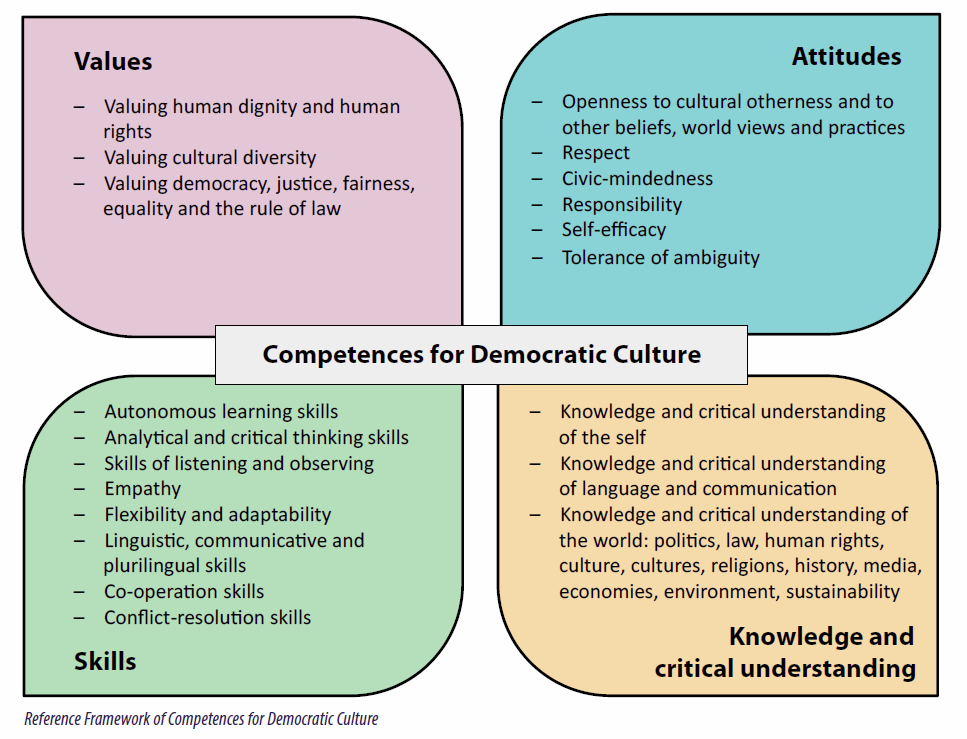
Values
Values are general beliefs that individuals hold about the desirable goals that should be striven for in life in democracy. They motivate action and serve as guiding principles for deciding on how to act as democratic citizen.
Attitudes
An attitude is the overall mental orientation which an individual adopts towards someone or something (for example a person, a group, an institution, an issue, as event, a symbol). The selected attitudes in the module are important for a culture of democracy.
Skills
A skill is the capacity for carrying out complex, well-organised patterns of thinking or behaviour in an adaptative manner in order to achieve a particular end or goal. The RFCDC identifies eight sets of skills that are important for a culture of democracy.
Knowledge and critical understanding
Knowledge is the body of information that is possessed by a person, while understanding is the comprehension and appreciation of meanings. The term “critical understanding” is used to emphasise the need for the comprehension and appreciation of meanings in the context of democratic processes and intercultural dialogue to involve active reflection on and critical evaluation of that which is being understood and interpreted.
How can this RFCDC be relevant in European higher education?
In the face of growing challenges to democracy, higher education has a critical role in equipping students with competences for active and responsible citizenship. Higher education fosters a culture of democracy through the transversal competences it develops in all its students, the way in which institutions are run, how the members of the academic community interact, and how higher education institutions see themselves and behave as actors in society at large.
To fulfil this democratic mission of education, learning outcomes of an education programme or course should be specified – what students should know, understand, be able and also willing to do, as both citizens and professionals. The RFCDC attempts to present these learning outcomes, which apply – with specificities – to all levels of education. For educators, trainers, policymakers, and organisations committed to inclusion and active citizenship, the Reference Framework of Competences for Democratic Culture offers practical guidance for embedding democratic culture into learning, teaching, and everyday practice.