
IN.TRA – Service-Learning in Specialized Translation
Institution:
University of BolognaCountry:
ItalyDiscipline:
Linguistics, Translation studiesLevel:
MADuration & intensity:
Year-course, 3 ECTSNumber of students:
70+Societal need addressed
- Improving access to information across linguistic and cultural barriers
- Providing language services to non-profit organisations and communities with limited access to professional linguistic support
Key competences for Democratic Culture
- Openness to cultural otherness, other beliefs, worldviews and practices
- Analytical and critical thinking skills
- Knowledge and critical understanding of language and communication
About the course
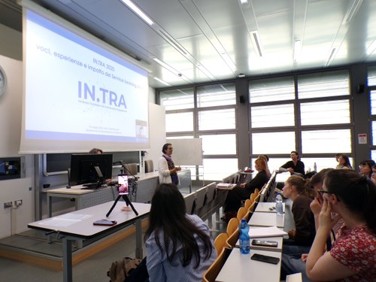
In IN.TRA – Service-Learning in Specialized Translation, master’s students apply their linguistic, intercultural and professional competences to real community needs while exploring the ethical and social responsibilities of translators and language professionals. Working through IN.TRA, the Department’s pro-bono language service initiative, students collaborate with non-profit organisations, associations and institutions to identify linguistic and communicative needs, co-design projects and turn academic learning into action through translation, revision, localisation, simplification, multilingual communication, educational workshops and language support. The course creates a learning environment where professional translation practice, ethical reflection and civic engagement come together in meaningful ways. The course typically culminates in a dissemination event where students present their projects and reflect on their work with community partners.
How are Competences for Democratic Culture developed?
Students develop civic-mindedness, responsibility and empathy by responding to real community needs and reflecting on the social consequences of linguistic and communicative choices. Collaborative project work with community partners strengthens cooperation, communication and agency, while engagement with multilingual and culturally diverse contexts encourages openness to different perspectives. Structured reflection throughout the experience fosters analytical and critical thinking, self-awareness and a deeper understanding of the relationship between language, access to information, inclusion and professional responsibility.
“The collaboration exceeded our initial expectations. It increased our awareness of new tools and techniques that could be useful in our field and stimulated reflection among the colleagues involved in the different activities. We are keen to continue the collaboration and make the most of the opportunities it offers. The interactions between the university students and the beneficiaries of the projects we work with were particularly valuable."
“The most positive aspect of the work I carried out was the sense of responsibility and social usefulness it gave me. Knowing that my linguistic and technical skills were being used to amplify the voices of hundreds of people silenced by institutions gave the whole project a profound sense of purpose. I am extremely satisfied with the project itself, as I feel that our group did justice to the rawness and truth of the original text.”
University-Community Partnership
Community partners involved
Various non-profit organisations, associations, and institutions, including:
- Cittadinanza Onlus
- Dialogos
- JL Project
- Radici Cosmiche
- Ma petite planète
- Villaregia Mission
Co-definition of the social need
Needs are identified through a participatory process involving community partners, teaching staff, and students. Initial meetings between partners and instructors define potential projects, which are then presented to students. Final project design emerges through dialogue, negotiation, and group formation based on students’ interests and competences.
Reciprocity & partner role
Students develop professional, ethical, intercultural, and civic competences through real-world practice, while community partners receive pro-bono language services (translation, localisation, workshops, dissemination). Partners primarly act as co-educator and co-designer of the project, as well as beneficiary of the service. The collaboration is based on mutual benefit and shared responsibility.
Pedagogical design
Curriculum integration
The course “Service Learning” is embedded in the MA in Specialized Translation and constitutes a compulsory pass/fail component of the final examination (3 out of 15 ECTS). It was originally an elective (6 ECTS) and has been institutionalised as a core curricular element. Service-learning is fully integrated into the curriculum, enabling students to apply translation, revision, terminology, and ethical competences to real community-based projects through the IN.TRA language service agency.
Learning objectives
- apply translation and language competences in real community contexts;
- develop ethical awareness and professional responsibility;
- understand the social role of translation and language mediation;
- foster critical thinking, reflection, and civic engagement;
- develop project management, teamwork, and communication skills.
Service & learning activities
Service activities
- translation, revision, and editing of texts;
- terminology work and multilingual communication;
- localisation and simplification of materials;
- workshops and Italian L2 support;
- dissemination and awareness-raising activities.
Learning activities
- theoretical input on service-learning, ethics, and active citizenship;
- familiarisation with community partners and needs;
- group-based project work and implementation;
- structured reflection (journals, discussions, reports).
Active role of the student
Students actively contribute to project design, group organisation, task definition, and communication with partners. They participate in decision-making regarding strategies, roles, timelines, and problem-solving, in dialogue with teachers and community partners.
Reflection
Reflection supports critical and democratic learning by enabling students to analyse the ethical, social, and political implications of their work. It helps them understand translation as a socially embedded practice that can either facilitate or hinder inclusion, participation, and access to information.
Assessment
The service-learning project constitutes a compulsory pass/fail component of the final examination (3 out of 15 ECTS).
Assesment methods:
- reflective diaries;
- self-assessment tests and questionnaires (pre/post);
- portfolio of activities;
- final reflective report (approx. 1000 words);
- partner satisfaction feedback.
Competences for democratic culture
Competences for democratic culture
Values
- Valuing human dignity and human rights
Attitudes
- Openness to cultural otherness and other beliefs, world views and practices
- Civic-mindedness
- Respect
- Responsibility
Skills
- Analytical & critical thinking skills
- Co-operation skills
- Empathy
- Flexibility and adaptability
- Linguistic, communicative and plurilingual skills
Knowledge and critical understanding
- Knowledge and critical understanding of language and communication
- Knowledge and critical understanding of the world
How are competences for democratic culture developed?
Comptences for Democratic Culture are developed through engagement with real community needs, collaborative project work, ethical decision-making, and structured reflection. Students critically examine issues such as access to information, linguistic inequality, representation, and the social impact of translation, linking professional practice to democratic participation and inclusion.
Outcomes & impact
Learning outcomes for students
- understanding of service-learning principles and methods;
- development of professional translation competences in real contexts;
- enhanced critical thinking, ethical awareness, and civic responsibility;
- ability to work collaboratively and manage projects;
- awareness of the translator as a linguistic and social mediator.
Community impact
The projects improve access to information, enhance the quality and accessibility of communication, and support the missions of community partners. Through pro-bono language services, organisations can reach wider and more diverse audiences and provide more inclusive communication and resources.
Challenges & conditions for success
Challenges
- alignment between academic timelines and community needs;
- organisational and logistical coordination;
- insurance and safety considerations for off-campus activities;
- maintaining reciprocity and avoiding charity-based framing;
- ethical issues related to quality, representation, and sensitive data;
- managing power relations between university and community.
Conditions for success
- availability of engaged community partners;
- institutional support (administrative, legal, organisational);
- alignment with disciplinary competences (e.g., translation/language programmes);
- clear learning objectives linked to ethics and social responsibility;
- structured reflection and evaluation framework;
- sustainable organisational structure (e.g., a coordinating unit like IN.TRA).