
Human Rights Clinic
Institution:
Matej Bel University Banska BystricaCountry:
SlovakiaDiscipline:
LawLevel:
BADuration & intensity:
Semester-courseNumber of students:
40-50Societal need addressed
- Awareness of human rights
- Antidiscrimination
- Principles of equality
Key competences for Democratic Culture
- Valuing human dignity & human rights
- Valuing democracy, justice, equality & the rule of law
- Openness to cultural otherness and to other believes, world views and practices
About the course
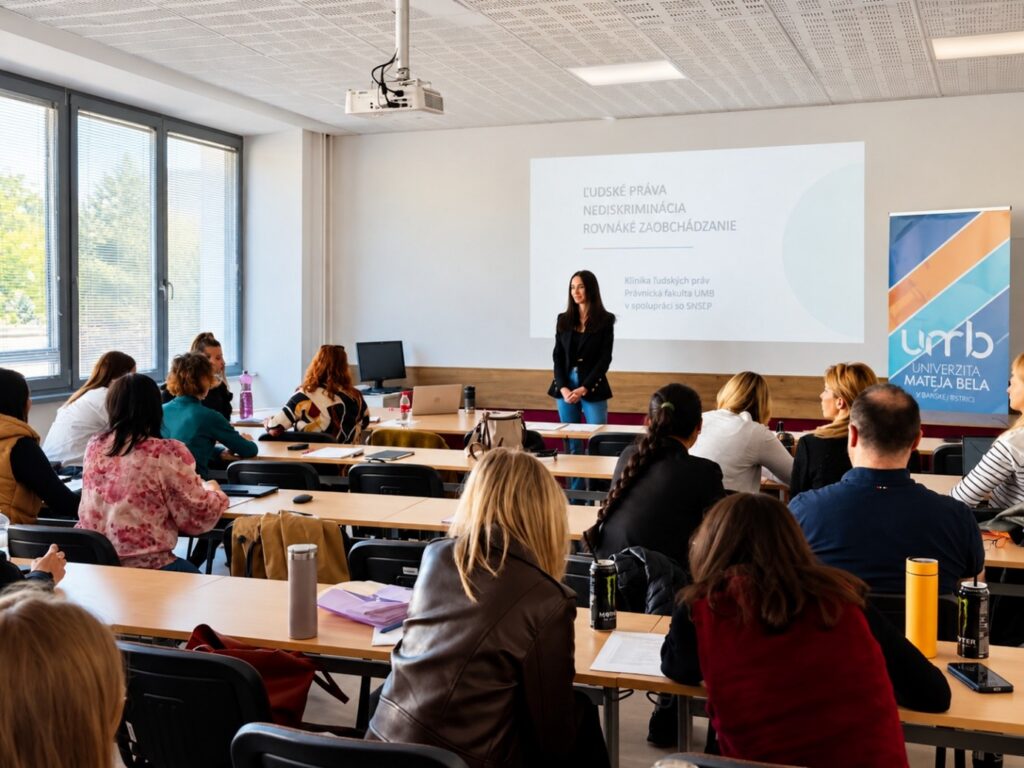
The Human Rights Clinic is a practical, human rights-oriented course combining legal education with practical activities aimed at strengthening awareness of human rights, non-discrimination and equal treatment in society. An important part of the course is the cooperation with the Slovak National Centre for Human Rights (SNSĽP), which is Slovakia’s National Human Rights Institution and Equality Body. The course introduces students to the role and functioning of National Human Rights Institutions, the Paris Principles and equality bodies. This is followed by a focus on the legal framework of the prohibition of discrimination, including the Constitution of the Slovak Republic, the Anti-discrimination Act and other relevant legislation. Students also work with selected case law of the Court of Justice of the European Union and the European Court of Human Rights and consider practical issues such as identifying a prima facie case of discrimination. The course also creates opportunities for students to encounter human rights issues from perspectives other than legal texts. Through the “Living Books” activity, students meet people who share their personal experiences of otherness and discrimination. Discussions with representatives of SNSĽP give students an opportunity to learn directly from professionals working in the field of human rights protection.
A central part of the course is the preparation and implementation of educational activities for schools and other groups. Students use the knowledge acquired during the course to prepare educational sessions on human rights, non-discrimination and equal treatment and subsequently deliver them to different audiences. The course therefore connects university-based legal education with engagement in the wider community. The course concludes with a reflection and feedback session in which students discuss their experience of implementing the educational activities, the challenges they encountered and what they learned through their engagement with the community.
How are Competences for Democratic Culture developed?
The preparation and implementation of the educational activities requires students to transform legal and theoretical knowledge into clear and accessible communication and to respond to questions and perspectives arising in direct interaction with participants. Students are not only recipients of knowledge but also actively contribute to raising human rights awareness among others. In the process, they develop practical legal, communication, presentation and interpersonal skills and gain experience in addressing sensitive issues related to discrimination and equality.
I had the opportunity to deliver an educational session at the secondary school I myself had attended. Introducing the students to the Slovak National Centre for Human Rights as a National Human Rights Institution and an Equality Body made me realise how important it is to be able to communicate legal and human rights issues in a clear and accessible way. I also valued the discussion that followed the educational session. The students’ questions and reactions made the experience interactive and gave me an opportunity to reflect on how human rights, non-discrimination and equal treatment can be explained and understood beyond the university classroom.
University-Community Partnership
Community partners involved
- Slovak National Center for Human Rights
- Elementary & secondary schools
- Family centres & children’s homes
- Roma communities
Co-definition of the social need
The Slovak National Center for Human Rights has the mission to provide education on human rights and anti-discrimination laws in various contexts and communities. Following an agreement with the center’s director, the Faculty of Law at Matej Bel University has taken over the educational programs in the Banská Bystrica region.
Reciprocity & partner role
The involved partners are co-designers of the course. Lawyers from the Slovak National Centre for Human Rights train students to teach on anti-discrimination laws and issues. Students respond to the communities’ needs by educating them on anti-discrimination issues. Within the communities, students adapt and become more sensitive to potential violations of anti-discrimination law.
Pedagogical design
Curriculum integration
The course “Human Rights Clinic” is programmed within the Bachelor of Laws. It builds upon several courses in which anti-discrimination law is applied—Labour Law, Constitutional Law, and European Law. It is an elective course in which students are tasked not only with understanding anti-discrimination law, but also with learning how to explain it to members of various communities.
Learning objectives
The curriculum focuses on raising awareness and fostering sensitivity regarding human rights and anti-discrimination issues. These topics are covered in several courses within the program that address anti-discrimination laws and human rights (Labour law, European law, Constitutional law, etc.).
Service & learning activities
- Service activities: Educational activities for schools and other groups on human rights and anti-discrimination law
- Learning activities: Understanding anti-discrimination laws and their application in practice
Active role of the student
The students’ task is to choose a community in which they will educate people about human rights and anti-discrimination law. They are free to select any community they believe has this need. Through developing the educational activities, students are not only recipients of knowledge but also actively contribute to raising human rights awareness among others.
Reflection
Reflection takes place in various ways during or after the completion of the SL project; this needs to be addressed to ensure that reflection is systematic.
Assessment
Evaluation of a final Report on Education. Teachers and students are engaged in the course assessment
Competences for democratic culture
Competences for democratic culture
Values
- Valuing human dignity & human rights
- Valuing democracy, justice, equality & the rule of law
Attitudes
- Openness to cultural otherness and to other believes, world views and practices
Skills
- Linguistic, communicative and plurilingual skills
How are competences for democratic culture developed?
Competences for democratic culture are rooted in the essence of human rights and anti-discrimination law. The added value is that students should not only passively master these laws as processes of enforcement, but also be able to explain them appropriately to non-professionals in various communities so that they can be applied. The preparation and implementation of the educational activities requires students to transform legal and theoretical knowledge into clear and accessible communication and to respond to questions and perspectives arising in direct interaction with participants. Students are not only recipients of knowledge but also actively contribute to raising human rights awareness among others. In the process, they develop practical legal, communication, presentation and interpersonal skills and gain experience in addressing sensitive issues related to discrimination and equality.
Outcomes & impact
Learning outcomes for students
- Awareness and sensitivity regarding human rights and anti-discrimination
- Proficiency in teaching methods related to these topics
- Community engagement
Community impact
- Raising awareness of the application of human rights and anti-discrimination laws,
- Increasing civic engagement and democratic competences development
Challenges & conditions for success
Challenges
The main challenge for students is adapting their language when communicating and learning about legal topics related to anti-discrimination and human rights
Conditions for success
- Apply appropriate teaching methods
- Identify community needs